

MENU
CLOSE
Delivered monthly to your inbox.
.jpg)
The core challenge — and the core opportunity — was light. Sandwiched between two adjacent units, the condominium had been starved of the natural illumination that defines great residential architecture. From bottom to top, the renovation was conceived as a reimagining of how light could move through the home: how it could be coaxed in, amplified, directed, and made to shift with the arc of the California day.
Windows were introduced in unexpected locations — cut into walls and roof planes where convention would have left them solid — creating focal points that add visual depth and a quiet sense of revelation. Each aperture was calibrated not just for light quantity but for light quality: the warmth of morning, the diffuse glow of midday fog, the amber of late afternoon filtering through new roof glazing above the expanded third floor.
"From bottom to the new top, the renovation was are imagining of how light could be exploited to enhance livability, warmth, and clarity in a home that had been held between its neighbors."
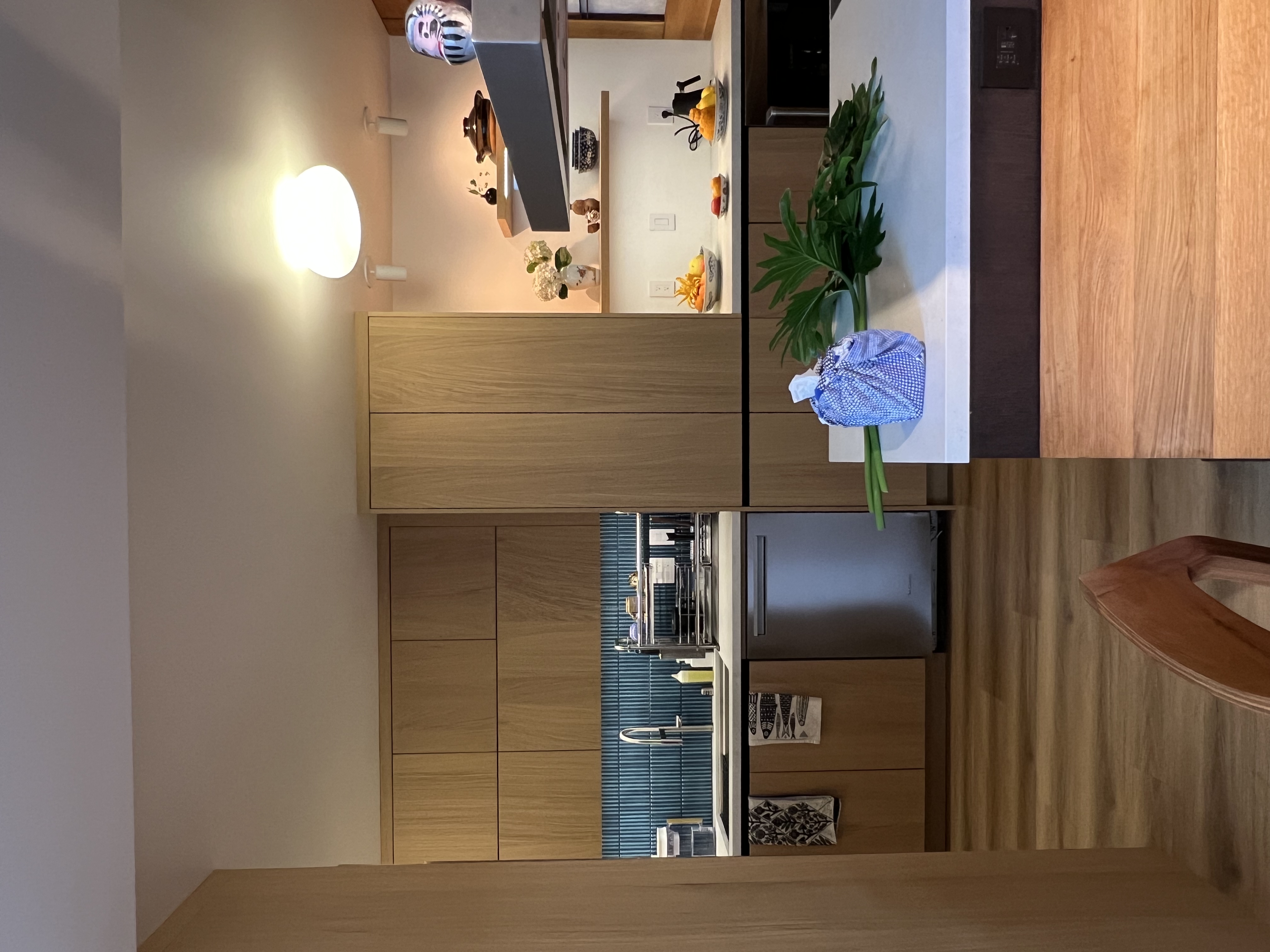
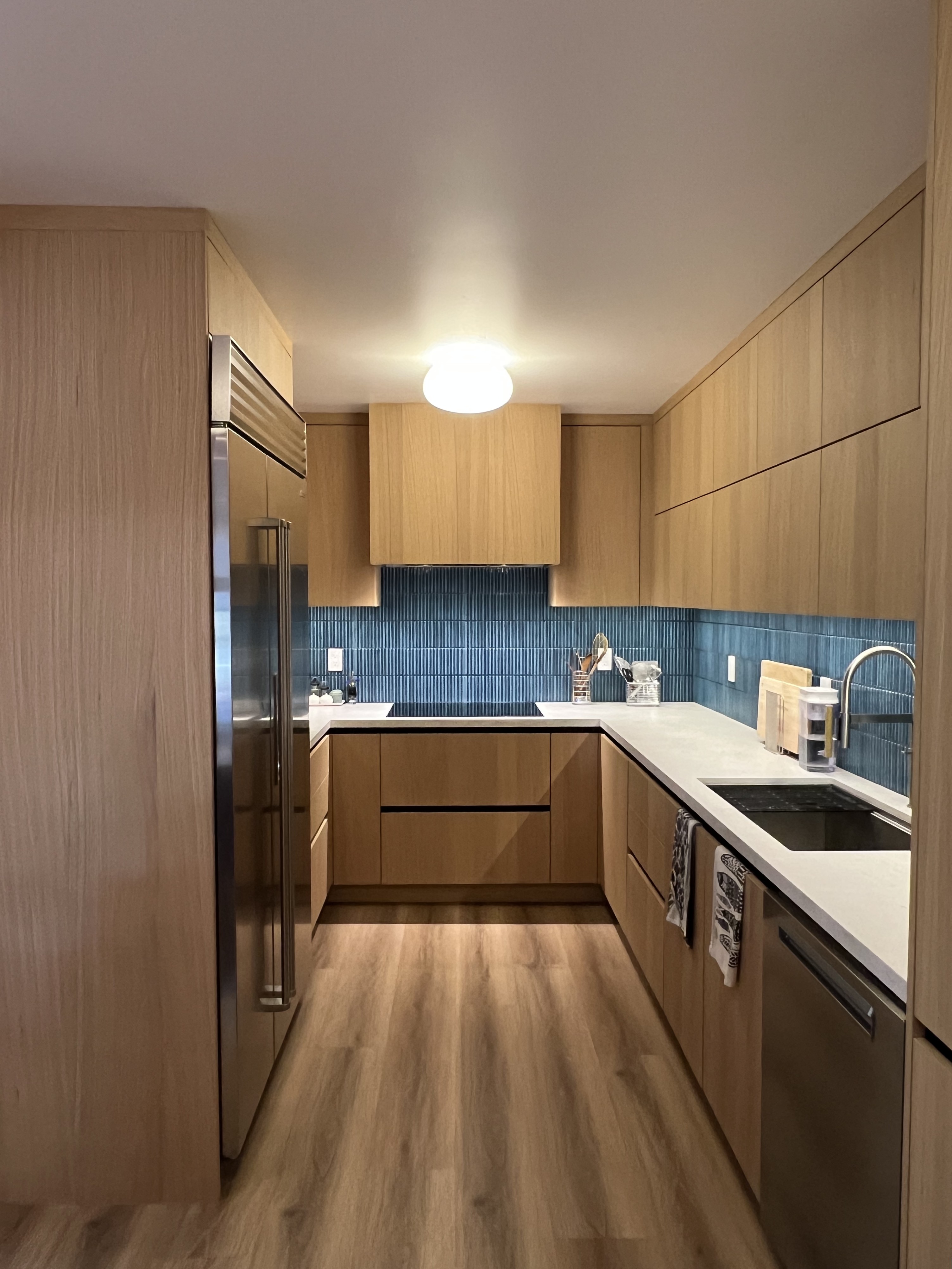
Kitchen with warm cabinetry and handmade tile backsplash
Double-height stair volume with unexpected window aperture
.jpg)
The design language that emerged — through close dialogue with the family — is best described as Japanese modern: a sensibility that prizes restraint, material warmth, and the beauty of the carefully considered detail. Warm-toned cabinetry anchors the kitchen and living areas, their grain and tone evoking the interiors of Kyoto teahouses translated into a contemporary California idiom. Handmade tile was selected for its subtle irregularity — each piece carrying the trace of its making — while maintenance-free countertops were specified to honor the realities of a working family's kitchen without sacrificing material quality.
Throughout, the palette draws from nature: the muted ochres and taupes of raked gravel, the deep greens of tatami moss, the cool silver of overcast Pacific light. Nothing shouts. Everything coheres.
Custom hot pot dining zone — a second eating environment designed for immersive, restaurant-style communal dining.
.jpg)
Among the project's most distinctive moves is the creation of a dedicated hot pot dining zone — a second eating environment conceived entirely around the ritual of communal cooking. Inspired by the convivial intimacy of Japanese and Korean restaurant culture, this bespoke space features a custom-built table with an integrated induction well, low seating, and its own lighting mood calibrated for the particular pleasure of a shared meal that unfolds over hours.
The result carries a quality that is difficult to name precisely but immediately felt upon entering: a sense of otherworldliness, of having stepped sideways into a space governed by different rules of time and purpose. For a family deeply connected to the rhythms and hospitality of Asian culture, it functions as both practical amenity and emotional anchor.
"The custom hot pot zone harks to an Asian-influenced entertaining style — a space where the ritual of the shared meal becomes architecture."
.jpg)
The bathrooms were designed as respites for peace and serenity — small rooms that earn their proportions through material richness and considered quietude. Handmade tile appears here again, applied to floors and walls with the precision of a Japanese artisan's hand. Windows were introduced in positions that convention would have overlooked: high on a gable, beside a shower threshold, adjacent to a soaking tub's edge. Each one delivers not just light but a focal point that draws the eye and expands the felt dimension of the space.
The vertical expansion into the attic permitted double-height spaces that transform the condo's interior world. Volume that was previously compressed is now released, and Italian pendant lighting — sourced for its sculptural presence as much as its illumination — hangs within these tall voids as objects of art as much as function. The drama is quiet but unmistakable.
Bathroom sanctuary with handmade tile and elevated window
New third-floor bedroom within the expanded attic volume
The Peter Coutts renovation stands as an argument for what contemporary design can achieve within the constraints of an existing structure and a shared building: that a modern architect's task is not to impose novelty but to find latent potential — in a ceiling plane, in a wall's thickness, in the angle of the afternoon sun — and release it with precision and care.
For this family, the home is now something it had never quite managed to be before: a place of warmth, ceremony, and quiet delight —one that carries the mark of a culture they hold close while standing entirely and confidently in its place on the Stanford campus.
1.jpg)
1.jpg)
1.jpg)
1.jpg)
1.jpg)
1.jpg)
Location
Peter Coutts Subdivision, Stanford University, Palo Alto, CA
Project Type
Full-Scale Residential Renovation & Vertical Expansion
Scope
Two-story condominium expanded to three floors with attic conversion
Aesthetic Direction
Japanese Modern / Warm Contemporary
Key Features
Double-height volumes, handmade tile, custom hot pot dining zone, Italian lighting
Architecture Firm
Larson Shores Architects — San Francisco Bay Area


.jpg)